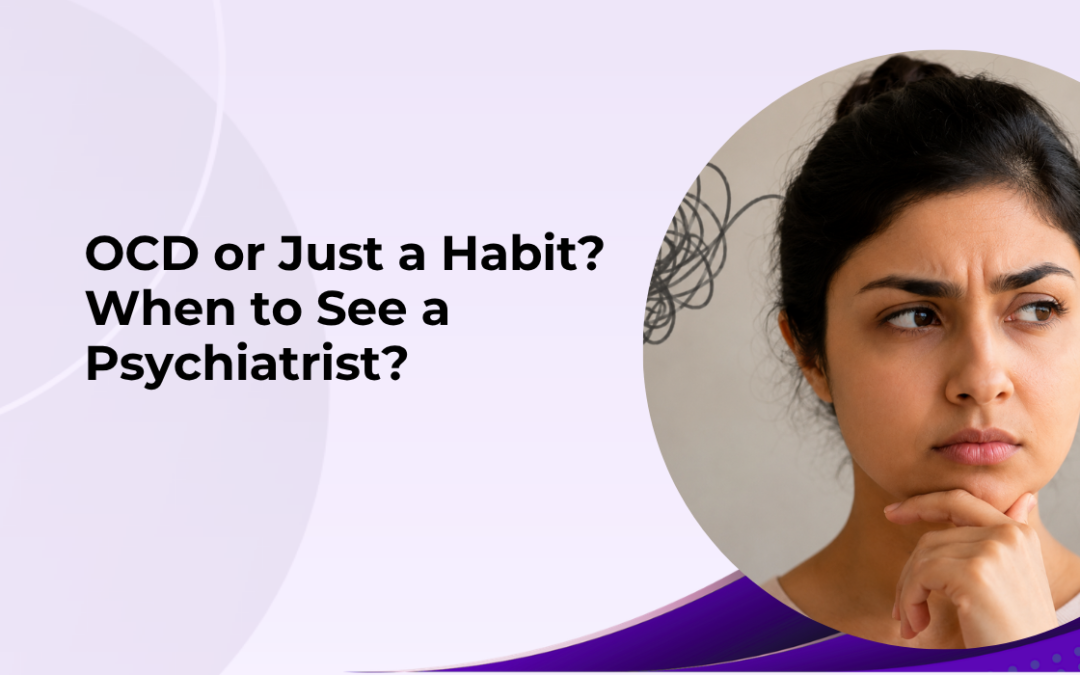
Checking the door twice before leaving. Washing hands after coming home. Arranging things a certain way. Everyday habits like these are voluntary and bring comfort or order. OCD is different. It features intrusive, involuntary thoughts that drive repetitive rituals meant to temporarily relieve distress, not produce it. The behaviour on the surface can look identical. What’s underneath is not. If these cycles are consuming over an hour a day and disrupting your life, that’s when a psychiatric evaluation makes sense.
According to Dr. Soumya Kamath, Psychiatrist in Mumbai, “OCD is not about being particular or clean. It is about being stuck in a loop you didn’t choose and can’t easily exit, no matter how hard you try.”
How Is OCD Actually Different From a Habit?
Most people conflate the two because the surface behaviour can look identical. Someone checking locks repeatedly looks the same whether it’s a habit or OCD. The difference is underneath.
A habit is automatic and neutral: You lock the door, check it once out of routine, move on. No distress attached. If you skip the check one day, nothing happens internally. Habits form because they’re useful or satisfying, not because skipping them causes fear.
OCD is driven by an intrusive thought: The checking in OCD isn’t really about the lock. There’s a thought, often intrusive and unwanted, telling you something terrible will happen if you don’t. You check. The anxiety drops briefly. Then the thought comes back. So you check again. The compulsion doesn’t solve anything; it just keeps the loop running.
The distress marker is the clearest indicator: People with OCD usually know their thoughts are irrational. That awareness doesn’t help much. The thought still arrives, still produces anxiety, and the compulsion still feels necessary. Habits don’t produce that cycle. If stopping a behaviour causes genuine distress and the thought driving it keeps returning, that’s worth discussing with someone. Structured OCD treatment breaks the obsession-compulsion loop rather than just managing symptoms on the surface.
When Does Repeated Behaviour Actually Need Psychiatric Attention?
Plenty of people live with mild repetitive tendencies and function completely fine. The threshold for seeking help isn’t about the behaviour itself but about what it’s costing.
Time is one indicator most people underestimate. Spending upwards of an hour a day on obsessive thoughts or the rituals they produce is clinically significant. It doesn’t always feel like an hour because it’s spread across the day, a few minutes here, a detour there, a thought you circled back to three times during a meeting. It adds up faster than people realise.
The other thing to watch is avoidance. When someone starts organising their life around not triggering certain thoughts or situations, that’s the pattern expanding. Taking a longer route to avoid something. Refusing to touch certain objects. Not letting others into your space because it disrupts an arrangement. These accommodations feel like solutions but they tend to make OCD stronger over time, not weaker.
Children and teenagers often present differently too. A child who can’t leave for school until something feels exactly right, who repeatedly asks for reassurance about harm coming to family members, or who gets intensely distressed when routines break unexpectedly, may be showing OCD rather than ordinary anxiety. Adults around them usually attribute it to personality. It’s worth a proper look. The same applies to anxiety treatment more broadly since OCD and anxiety disorders frequently coexist and feed each other. If panic attacks are part of the picture too, understanding how to stop a panic attack is a useful starting point while getting assessed.
Why Choose Dr. Soumya Kamath for OCD Care?
Dr. Soumya Kamath completed her MBBS and MD in Psychiatry from Dr. D. Y. Patil Hospital, Navi Mumbai. Practising since 2020. Recipient of the Award of Excellence for Best Postgraduate Student in Psychiatry. Consults at Mindspace Mental Wellness Centre, Kandivali West and SM Diagnostics & Polyclinic, Goregaon West. Sees adults, elderly patients, and children across all age groups. Every treatment plan built from scratch. No copy-paste consultations.
📞 Call Now: +91 7304066764 Book An Appointment
FAQs
Can a habit turn into OCD over time?
Not really. Habits don’t carry anxiety. If skipping the behaviour makes you genuinely distressed, or a thought is pushing the repetition rather than just routine, that’s a different situation and worth checking out.
Is OCD just about cleanliness and checking?
It gets typecast that way. But OCD shows up around thoughts about harm, relationships, religion, symmetry, and a lot of things that have nothing to do with germs or locks. Many people live with it for years without recognising it because it looks nothing like what they’ve seen portrayed.
How much time spent on rituals is considered a problem?
There’s no exact number but psychiatrically, more than an hour a day is significant. The trickier part is that it rarely feels like an hour. It’s ten minutes here, a thought you returned to twice in a meeting, a detour you took without really deciding to. It adds up.
Can OCD be treated without medication?
Some people do well with therapy alone, particularly ERP. Others need a combination. It depends on how severe the symptoms are and how long they’ve been running. A psychiatrist can work that out after a proper assessment, there’s no single answer that fits everyone.
References
Book an Appointment |
Book a Consultation with Dr. Soumya Kamath to understand the difference between OCD and a habit and determine when it is time to see a psychiatrist for professional guidance.