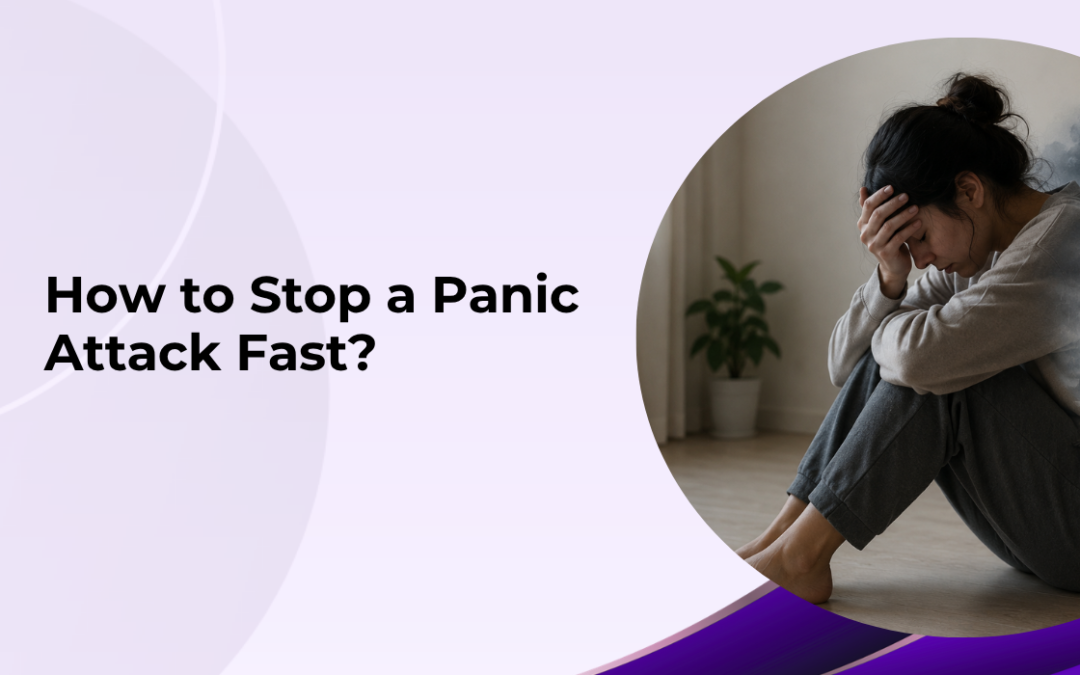
Heart pounding Chest tight Feels like something terrible is about to happen. To stop a panic attack quickly, the goal is to break the body’s fight-or-flight response by anchoring your mind in the present and sending safety signals to your nervous system. Slow, controlled breathing does that faster than anything else. Most attacks peak in under 10 minutes and pass on their own. Not life-threatening. But terrifying while it lasts.
According to Dr. Soumya Kamath, Psychiatrist in Mumbai, “A panic attack is the body’s alarm going off when there’s no real threat. The fastest way to stop it is to stop fighting it and work with your breath instead.”
What Techniques Actually Stop a Panic Attack in the Moment?
When a panic attack hits, the body shifts into fight-or-flight. Heart rate spikes. Breathing turns shallow. These techniques interrupt that cycle.
Slow your breath down: Box breathing works. Inhale for 4 counts, hold for 4, exhale for 4. Three rounds of this and most people feel the sharpest edge come off. It tells the nervous system the threat isn’t real. The body listens faster than the mind does.
Try the 5-4-3-2-1 method: Name 5 things you can see right now. 4 you can physically touch. 3 sounds you can hear. 2 smells. 1 taste. It sounds simple because it is. It works because it forces attention out of the panic spiral and into the actual room you’re sitting in.
Release the tension your body is holding: Panic tightens everything without you noticing. Jaw clenched. Fists closed. Stomach hard. Start from your face and consciously let go downward. Shoulders. Hands. That physical release sends a signal up. The brain registers it.
Stop fighting the attack itself: Trying to make a panic attack stop faster usually makes it worse. The more you fight the sensations, the more intense they get. Letting the wave rise and fall without adding to it cuts the duration down. It always passes. Every single time. If attacks are becoming a pattern, structured anxiety treatment addresses what’s driving them, not just the episodes themselves.
Look at caffeine and sleep honestly: Both matter more than most people want to admit. Caffeine raises baseline anxiety. Poor sleep lowers your threshold for attacks. Cutting
What Helps Reduce Panic Attacks Over Time?
Stopping one attack is different from stopping them from coming back. That takes work between episodes, not just during them.
Track what happens before an attack: They rarely come from nowhere. Sleep was bad. Three coffees. A crowded local train. A particular thought loop. Most people never connect these dots until they write it down. Even a simple note on your phone, time and what you were doing, reveals patterns within a few weeks.
Practise breathing before you actually need it: Box breathing and slow exhales work best when the body already knows them. Five minutes daily means when an episode hits, you’re running something familiar, not learning it. Anxiety and OCD often overlap too — worth reading about OCD vs habits if both feel present.
g back, or at least shifting coffee to earlier in the day, makes a measurable difference for a lot of people. Not a fix on its own. But it removes fuel.
Get assessed if it keeps happening: One attack might be a one-off. Two or more, especially if you start reorganising your life around avoiding them, is worth a proper psychiatric evaluation. The pattern tends to grow if left alone. Treatment stops it before avoidance becomes the default. It’s also worth knowing that anxiety and low mood often show up together. Reading about the early signs of depression can help you catch both early.
Why Choose Dr. Soumya Kamath for Panic Attack and Anxiety Care?
Dr. Soumya Kamath completed her MBBS and MD in Psychiatry from Dr. D. Y. Patil Hospital, Navi Mumbai. Practising since 2020. Recipient of the Award of Excellence for Best Postgraduate Student in Psychiatry. Consults at Mindspace Mental Wellness Centre, Kandivali West and SM Diagnostics & Polyclinic, Goregaon West. Sees adults, elderly patients, and children across all age groups. Every treatment plan is built from scratch based on the individual. No copy-paste consultations.
📞 Call Now: +91 7304066764 Book An Appointment
FAQs
How long does a panic attack usually last?
Most peak in under 10 minutes. Full resolution usually happens within 20 to 30 minutes, though it rarely feels that way when you’re in it.
Can panic attacks cause a heart attack?
No. The symptoms overlap enough that it’s easy to confuse them, but panic attacks aren’t dangerous to the heart. If you’re unsure, a doctor can rule out cardiac causes.
Does breathing really help stop a panic attack?
It does, more than people expect. Slow exhales specifically signal the nervous system to stand down. The catch is it works better when you’ve practised it before needing it.
When should I see a psychiatrist for panic attacks?
When you notice you’ve started making decisions around them. Different route home, skipping the lift, avoiding certain situations. That’s when it’s worth getting assessed.
References
Book an Appointment |
Book a Consultation with Dr. Soumya Kamath to understand how to effectively manage panic attacks and discover personalized strategies to regain control over your mental well-being.