By the time kids reach the age of 2, they are running about everywhere, unable to hold their attention on a story, and are able to go from giggles to tears within a mere few minutes. So websites that parents look up late at night, such as “ADHD symptoms toddler,” can be more worrisome than informative. Here you’ll get all that you can watch, what you can watch, and what you should talk to a professional about.
“Most concerns of parents at this age are about normal development and not a disorder. It is not about labeling a 2-year-old; it is about paying attention to the pattern when it is worth doing so”, says Dr Soumya Kamath, Psychiatrist in Mumbai.
Can a 2-Year-Old Have ADHD?
In short, no, not in the way parents often assume. The American Academy of Pediatrics recommends screening for ADHD starting at age 4, when behaviour in structured settings can be judged more accurately. Nationally representative data show about 9.4% of children aged 2–17 have been diagnosed with ADHD at some point, but that drops to roughly 2.4% for ages 3–5, and lower still at age 2. Some early behaviours can raise a flag, and clinicians sometimes note “early signs,” but a diagnosis this young is rare, mainly because normal toddler behaviour overlaps so heavily with what ADHD looks like on paper.
Watch this video for a simple explanation of ADHD symptoms in young children and what parents should know
Not sure if it’s just a phase? Dr. Soumya Kamath offers parent consultations to help you read your child’s behaviour clearly, without jumping to conclusions.
What Are the Common Symptoms of ADHD in 2-Year-Olds?
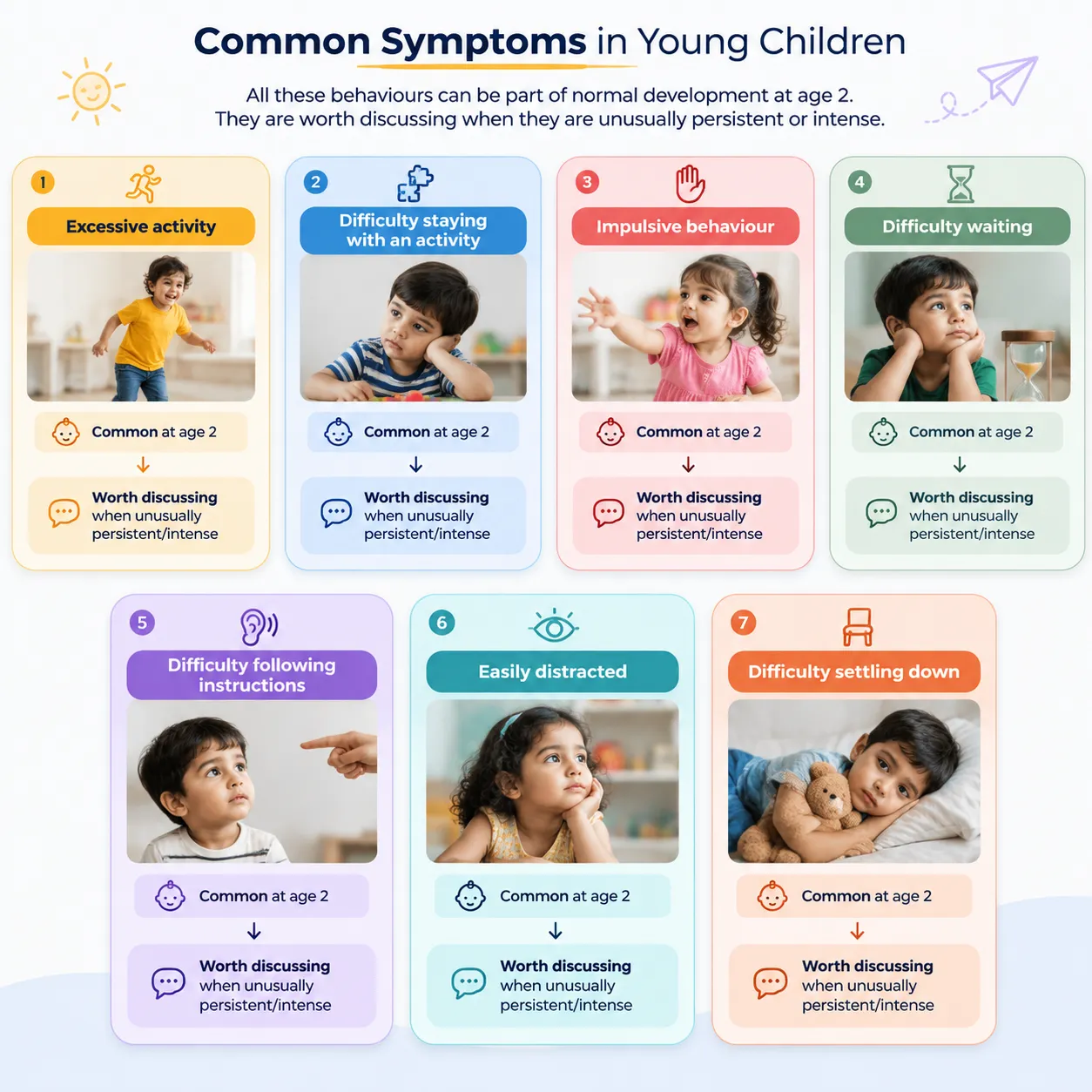
ADHD-type behaviour into three broad categories: inattention, hyperactivity, and impulsivity, and a child may lean toward one pattern or show a mix of all three.
- Excessive activity: Constant motion is normal; concern grows when there’s no calm stretch at all, ever.
- Short attention span: Losing interest fast is typical. Concerning if they can’t engage with anything, even for a few seconds.
- Impulsive behaviour: Grabbing or darting off is normal. Worth noting if it creates real safety risks, even with supervision.
- Trouble waiting: All toddlers struggle to wait. Concerning if they can’t tolerate even a few seconds without distress.
- Trouble following instructions: Simple steps are expected to be missed sometimes. Concerning if even the simplest, familiar instruction is never followed.
- Easily distracted: Normal for this age. Concerning if they never return to the activity after a distraction.
- Can’t sit still: Squirming is typical. Concerning if they never settle, even briefly, with a calm adult nearby.
How Do ADHD Symptoms Differ From Normal Toddler Behaviour?
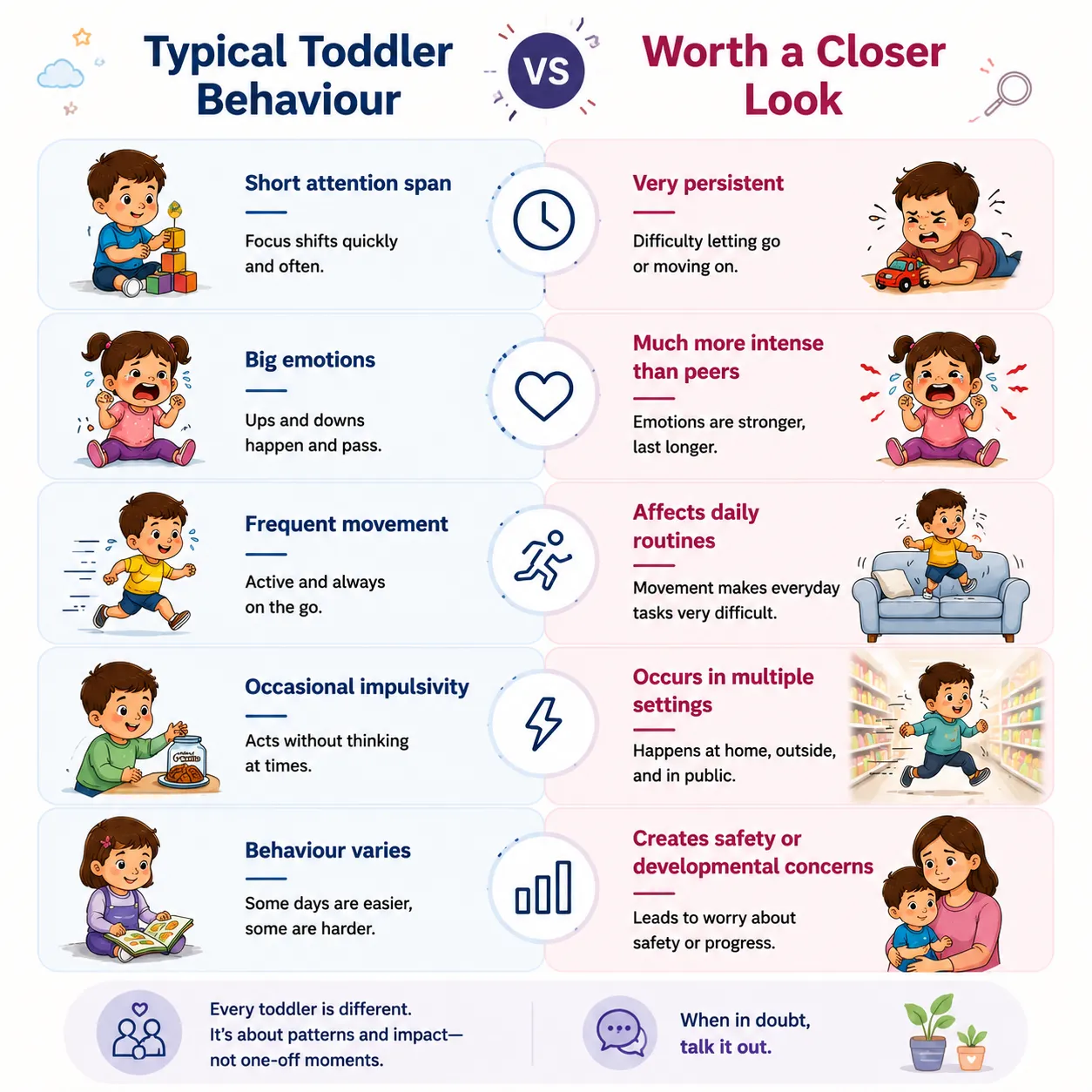
It’s not what the behaviour is; it’s how intense, constant, and cross-setting it is that matters.
Aspect | Typical at Age 2 | Worth a Closer Look |
Attention span | Naturally short | Rarely a factor alone |
Self-control | Still developing | N/A — expected to be immature |
Emotional reactions | Big, fast feelings | Extreme, doesn’t ease with comfort |
Sleep | Occasional disruption | Frequent disrupted sleep + high nighttime activity |
Pattern | Behaviour varies by setting | Intense, constant, and across every setting |
Diagnosis timing | Not evaluated at 2 | AAP evaluation window opens at age 4 |
Want a professional read on your child’s behaviour? Dr. Kamath can help you separate normal toddler intensity from patterns that genuinely warrant follow-up.
What Other Conditions Can Cause ADHD-Like Symptoms in Toddlers?
Several unrelated issues can produce behaviour that looks a lot like ADHD, which is exactly why clinicians rule these out first.
Hearing problems can make a child seem inattentive when they simply can’t hear well.
Sleep disorders, including sleep apnoea, can independently cause hyperactive, impulsive-looking behaviour.
Language delay can lead to frustration and inattentiveness that has nothing to do with ADHD. Anxiety can mimic restlessness and poor concentration, especially in unfamiliar settings.
autism spectrum disorder frequently overlaps with, or co-occurs alongside, attention and activity difficulties.
Checked a few boxes above? That’s worth a conversation, not a diagnosis.
When Should Parents Talk to a Psychiatrist?
A smaller set of patterns is worth raising with a professional sooner rather than later; none confirm ADHD alone, but together they’re reason enough for a developmental review:
- Behaviour clearly more intense than same-age peers
- Symptoms showing up across every setting, not just one
- Real disruption to daily routines: meals, sleep, or play
- Loss of a skill or word the child previously had
- Impulsivity that creates genuine safety risks, even with supervision
A proper evaluation, when a child is old enough, typically follows this sequence:
- Detailed parent interview
- Behaviour checked across settings: home, preschool, other caregivers
- Ruling out look-alike causes: hearing, vision, sleep, language issues
- Structured rating scales and direct observation
- Parent training in behaviour management tried first (ages 4–6), before any diagnosis is confirmed
FAQs
Can a paediatrician or psychiatrist diagnose ADHD in a 2-year-old?
In practice, formal diagnosis is uncommon this young. Guidelines direct clinicians to evaluate from age four onward, so most professionals monitor and support rather than diagnose at two.
My 2-year-old never stops moving. Should I be worried?
Usually not on its own. High energy, especially around age three, is developmentally typical. It’s the combination of constant motion with no calm stretch, across every setting, that’s worth mentioning to a professional.
Does poor sleep make ADHD-like behaviour worse?
Yes, disrupted sleep is linked with more hyperactive, inattentive-looking behaviour in toddlers, and can produce ADHD-like symptoms even in a child without ADHD.
What should I do first if I'm concerned?
Start with your child’s paediatrician to rule out hearing, vision, or sleep issues, and note when and where the behaviour happens. A psychiatrist or developmental specialist can help if concerns persist.
Will early intervention help even without a formal diagnosis?
Yes. Structured routines, consistent responses to behaviour, and professional guidance can support a child’s development regardless of whether a formal ADHD diagnosis is ever made.

Trackbacks/Pingbacks