Younger-onset dementia, or early-onset dementia, is a cognitive decline that starts before the age of 65. It affects memory, thinking, language, behaviour, and judgement, and tends to creep in when an individual is in their 40s or 50s. Due to the symptom overlap with stress, burnout, menopause or other psychiatric illnesses, the number of unidentified cases over the years continues to exist without a confirmatory diagnosis. Alzheimer’s, Fronto-Temporal, Vascular and Lewy Body Dementia are some of the variants of Dementia that not many may know about. Although the condition is progressive, early diagnosis provides a window for various treatment modalities, which can help delay its progression and equip families with the right skills to manage their loved ones and themselves.
Dr. Soumya Kamath, psychiatrist in Mumbai, says, “When a person, before the age of 65, begins to experience forgetfulness, has difficulty performing day to day activities, the things they used to perform with ease, it is always better to get evaluated. Early assessment may help provide answers as well as improve their quality of life in whatever capacity possible.
Watch this informative video to understand the early signs, causes, and challenges of younger-onset dementia, a condition that can affect adults well before the age of 65.
Learning Early Warning Signs.
Initial symptoms of dementia in younger adults are hardly explosive. They appear in the form of small and repeated slips, which family members are aware of before the individual himself. This is what to look at.
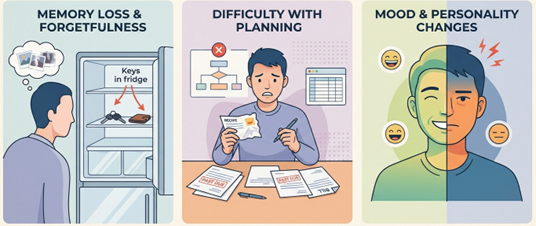
Memory Loss and Forgetfulness.
The first to be affected is short-term memory. You may forget something you said yesterday, repeat yourself, lose things in unusual places, such as keys in the fridge. It is natural to be forgetful occasionally. However, it is worth noting when it becomes a trend.
Issues with Planning and Problem-Solving.
Cooking the same recipes which they have been doing for many years, managing money, such as paying bills or doing certain transactions without assistance, may all start to become overwhelming. Individuals with early-onset dementia usually get confused with tasks requiring multiple steps and are unable to continue them after losing track.
Mood and Personality Change.
A shy individual can appear extroverted. A jolly one might become flat & full of himself. Such changes may resemble those naturally occurring during periods of stress or life changes, which may cause it to be frequently overlooked by family members.
Seeing these signs in yourself or someone you love? Schedule a mental health appointment.
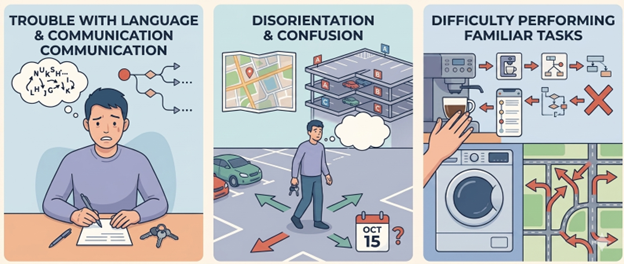
Problems with Language and Communication.
You look at someone or something familiar and are unable to name them. Sentences break off in mid-thought. Speech and word recall suffer an early blow.
Disorientation, Confusion.
Losing the time of day, day of the week, date, the season, and the meals you have eaten on that day is a warning. Some individuals even lose the location of their parked vehicle in a locality they visit on a weekly basis.
Problems with Doing Routine Activities.
Travelling a familiar road, using the dishwasher or washing machine or opening a favourite application may become confusing. The steps are somewhere, but the brain is not able to sequence them.
Weak Judgment and Decision-Making.
Uncharacteristic financial decisions. Getting duped by blatant deceptions. Neglecting personal grooming. Such a judgment lapse is usually the indicator that can make families take action.
Abandonment of Social Activities.
It is typical to withdraw from oneself, friends, hobbies, and work talks. In part, due to exhaustion. In part due to the difficulty of keeping up with it, which is more challenging than before.
Early identification of such signs is a difference. Should you wish to learn more about how mood symptoms may coexist with cognitive alterations, our depression treatment guide is a good place to jump off.
When to See a Doctor.
In case the symptoms have been persistently present for many weeks, are progressively increasing with time, affect work or relationships, or are observed by more than one family member, it is time to visit a specialist, such as Dr. Soumya Kamath. Wait, not until things are worse. Before proceeding with a more thorough examination, a psychiatrist or neurologist can exclude reversible causes, such as thyroid, B12 deficiency, or depression.
Diagnosis and Evaluation Process.
It is typically diagnosed through a meticulous clinical interview, cognitive screening examinations, such as MMSE or MoCA, blood tests, and brain scans, such as MRI or CT. Neuropsychological testing is occasionally included in the clinic of Dr. Soumya Kamath to chart particular strengths and weaknesses. It is not only to name the condition. It is to determine the kind, phase and reversible factors.
Concerned about changes in memory or behaviour in a loved one who is under 65? Arrange a comprehensive dementia assessment to be clear and follow up.

Management and Treatment.
No cure is yet known. Nevertheless, the decline may be slowed, and quality of life can be enhanced through treatment. Dr. Soumya Kamath prescribes medications which include cholinesterase inhibitors and receptor-targeted treatments to aid with cognitive symptoms. Antidepressants or antipsychotics are also used in tandem to help with the mood symptoms and behavioural changes that are associated with Dementia. In addition to medication, organized routines, activities to stimulate cognition, exercise, and certain diets have also shown clinical benefit.
It is also important to empower family members with the right skills so that they know how to care for their loved ones.
Living with Early-Onset Dementia.
A diagnosis of less than 65 is emotionally burdensome. The careers, money and children at home are all impacted simultaneously. However, with the right support, many of the patients of Dr. Soumya Kamath remain able to live full, meaningful lives, many years after being diagnosed. Legal planning, work modifications and streamlining daily routines at the beginning of a career go a long way in the future.
Support Systems and Caregiving.
Dementia is known to cause immense caregiver burden, and burnout is frequent. Dr. Soumya Kamath urges the families of individuals with Dementia to seek support, counselling and training to care adequately without draining themselves. Self-care shouldn’t be a luxury; it’s a necessity. By doing so, we are not just able to care better for the patient but also are able to engage the family in meaningful and productive discussions. This helps them make better decisions.
Seek professional psychiatric advice for your family. Get to know Dr. Soumya Kamath when it comes to caring about dementia in Mumbai.
FAQs
What is the typical age of onset of early-stage dementia?
When the diagnosis of Dementia is made by a mental health professional, is before the age of 65, it is called early-onset Dementia. Because this illness is easy for individuals & family members to misdiagnose themselves with, it’s always better to consult a professional.
Is dementia at an early age inherited?
Early-onset Dementia has a stronger likelihood of being inherited. Although having a family history increases risk, most dementia results from a mix of age, environment, and lifestyle factors.
Is it possible to reverse early-onset dementia?
If Dementia occurs due to certain deficiencies, metabolic factors, infections etc., one might be able to see a reversal of symptoms. But otherwise, Dementia is not reversible. Early diagnosis can slow down the progression, thereby improving outcomes.