
You sit down to finish a report, and twenty minutes later you’re three tabs deep into something completely unrelated, not even sure how you got there. It’s not laziness, and it’s not a lack of willpower. For a lot of people, this is simply what ADHD and concentration look like day to day.
“A lot of patients come in thinking they’re just undisciplined,” says Dr. Soumya Kamath, a psychiatrist in Mumbai. “Once we actually look at the pattern, it’s clear the brain isn’t lacking effort; it’s lacking the right kind of structure to direct that effort.”
What Is ADHD and How Does It Affect Concentration?
Attention-Deficit/Hyperactivity Disorder (ADHD), is a neurodevelopmental condition that changes how the brain manages attention, impulse control, and executive function. It’s not about being unable to focus at all; it’s about the brain struggling to choose what to focus on and stick with it.
Someone with ADHD can hyperfocus on a video game for three hours straight but can’t sit through a ten-minute email. The issue isn’t attention span. It’s attention regulation.
Do you notice this pattern in yourself or your child? Connect with a specialist to understand what’s really going on.
Why Do People With ADHD Struggle With Concentration?
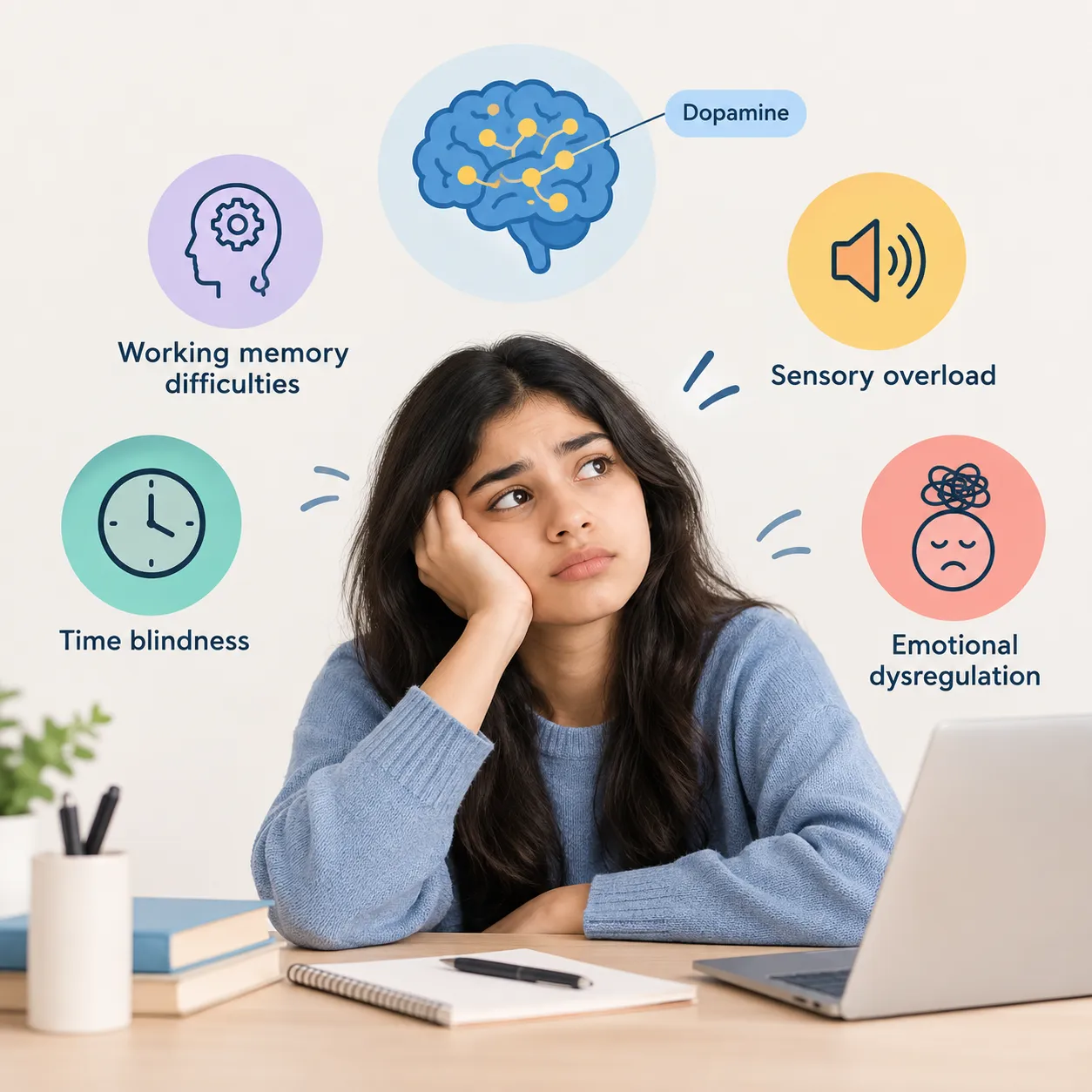
The short answer: dopamine. ADHD brains process dopamine differently, and dopamine is what helps the brain register a task as worth paying attention to. When a task feels boring, repetitive, or doesn’t offer quick feedback, the ADHD brain genuinely struggles to engage with it, even when the person wants to.
A few other things play into ADHD and attention problems:
- Working memory difficulties — holding onto instructions or steps while doing something else
- Time blindness — losing track of how much time has actually passed
- Sensory overload — background noise or clutter pulling focus away constantly
- Emotional dysregulation — frustration or anxiety making it even harder to settle into a task
Is It ADHD or Just Normal Distractibility?
Everyone gets distracted sometimes. The difference lies in consistency, duration, and impact on daily life.
| Aspect | ADHD-related focus problems | Normal distractibility |
| Onset | Pattern present since childhood | Can appear at any age, usually situational |
| Consistency | Shows up across multiple settings: school, work, home | Occasional, tied to specific circumstances |
| Duration | Persistent, ongoing | Temporary, resolves with rest or less stress |
| Impact | Interferes meaningfully with work, study, or relationships | Minor inconvenience, rarely disruptive |
| Care approach | May need clinical evaluation and structured support | Usually managed with better routines or rest |
Could your focus struggles be more than just a bad week? Let’s find out together.
Common Signs of ADHD-Related Concentration Problems
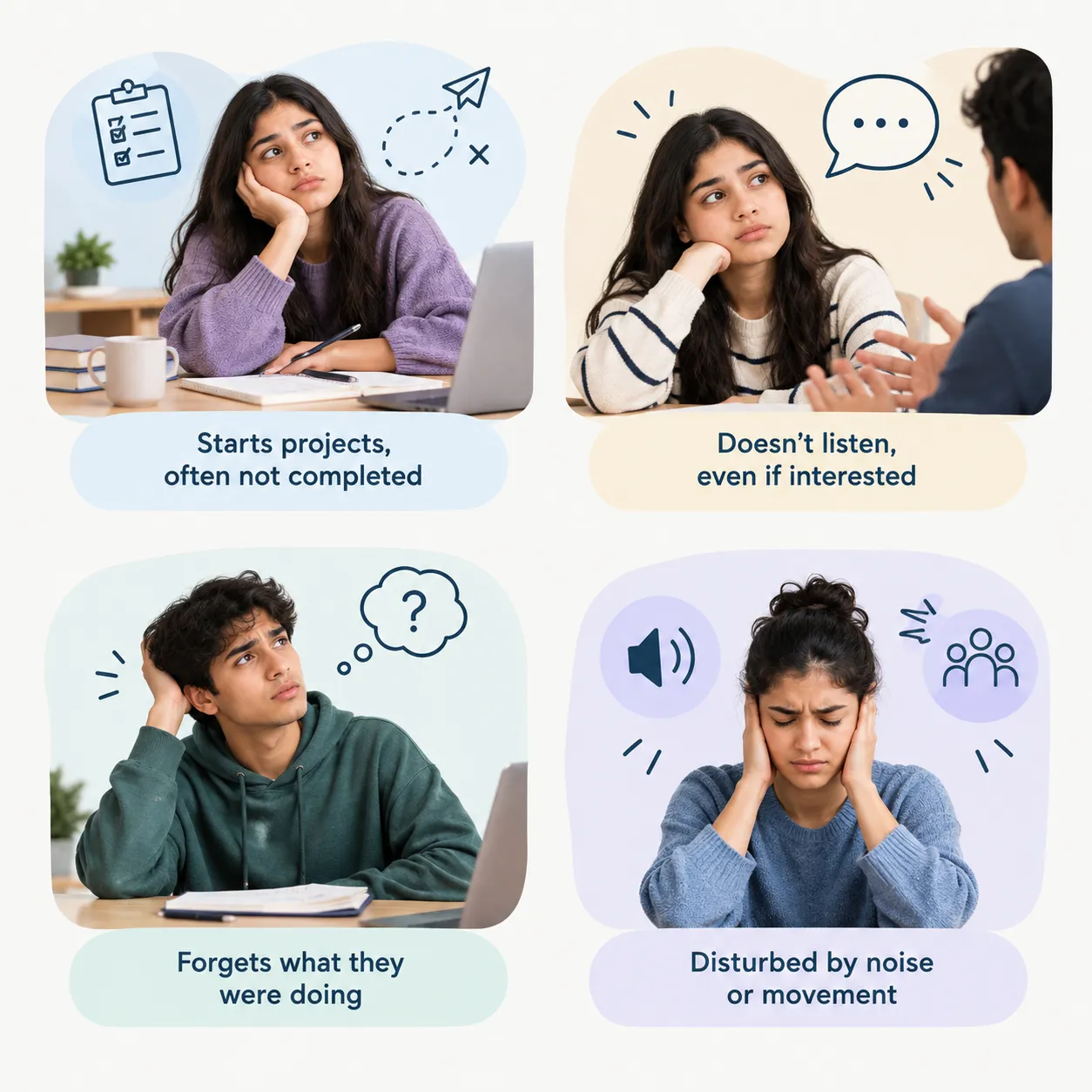
These are some of the most frequent ADHD symptoms impacting attention:
- Beginning work on projects and projects that often aren’t completed.
- When the person is not paying attention to what you are saying, even if they are interested in what you are saying
- After a short pause, forgetting what you were doing
- Disturbed by noise or movement
This isn’t something that happens once in a while. They don’t appear only when they are fatigued or stressed but repeatedly, in different contexts.
ADHD and Concentration While Studying or Working
This is where ADHD and studying struggles become most visible. Reading a textbook page without absorbing a word, rereading the same line five times, or opening a document and immediately feeling overwhelmed these are everyday realities, not signs of not trying hard enough.
At work, it often looks like missed deadlines despite genuine effort, half-finished projects, or needing far more time than colleagues for tasks that aren’t actually that complex. The frustration compounds because the person usually knows exactly what needs to get done. Knowing isn’t the problem. Executing consistently is.
How Is ADHD-Related Difficulty Concentrating Evaluated?
There isn’t one test for ADHD. A psychiatrist will review your developmental history, symptoms in various contexts, and possibly structured rating scales and a thorough clinical discussion. The aim is to look at the bigger picture rather than the tick boxes, and then there will be a treatment plan that fits the person in front of them.
How to Improve Concentration With ADHD
There is no one single solution, but there are some strategies that really work to help focus with ADHD:
- Divide tasks into smaller segments — a 25-minute segment of “work” seems so much more manageable than “the whole project.
- Clear away the visual clutter before you begin
- Provide outside structure that the brain will lean on (timers or alarms)
- Do short bursts of work with good rest in between
- Choose energy times (high-energy periods) for tasks requiring the most concentration
Reading out loud, summarizing each paragraph in the student’s own words, or studying for short periods of time is more effective than trying to study for long periods of time without making sound eye contact with the student.
When Should You Seek Professional Help for Concentration Problems?
If the problems with concentration have been happening for months, early in life, and are interfering with your work, your relationships, or your self-confidence, it’s worth talking to a professional. This is particularly true if you’ve exhausted the productivity hacks and they don’t seem to hold up for long.
Dr. Soumya Kamath shares that it matters when focus problems are beyond the norm because once the pattern is understood and the right support plan is in place, everyday functioning is significantly improved as well.
Unsure whether an evaluation is the right next step? Discuss your concerns with a specialist.
FAQs
Is poor concentration always a sign of ADHD?
No. Stress, sleep deprivation, anxiety, and even certain medical conditions can all cause concentration issues. ADHD is considered when the pattern is longstanding, consistent, and traceable back to childhood.
Can adults develop ADHD-related concentration problems later in life?
ADHD itself doesn’t develop in adulthood, but many adults are diagnosed later because their symptoms were missed or misread as something else when they were younger.
Does ADHD affect focus the same way in everyone?
Not at all. Some people struggle mainly with starting tasks, others with finishing them, and some swing between hyperfocus and complete distraction depending on the task.
Can lifestyle changes alone fix ADHD-related focus issues?
Not at all. Some people struggle mainly with starting tasks, others with finishing them, and some swing between hyperfocus and complete distraction depending on the task.
Can lifestyle changes alone fix ADHD-related focus issues?
They can help manage symptoms, but for many people, lifestyle changes work best alongside professional support rather than as a standalone fix.