All four-year-old toddlers have a million questions and go at their own pace. It’s sometimes when a parent can see that their child is not playing like other children and they cannot get it out of their head. It’s a guide to the signs of autism in a 4 year old in ordinary language terms, and you’ll know what to look out for and what is just a phase.
Dr Soumya Kamath, Psychiatrist in Mumbai says, “A parent’s observation is valuable as you know your child better than any checklist. Parents are always the first ones to tell me that they felt something was different, before anyone else does.
What Are the Signs of Autism in a 4-Year-Old?
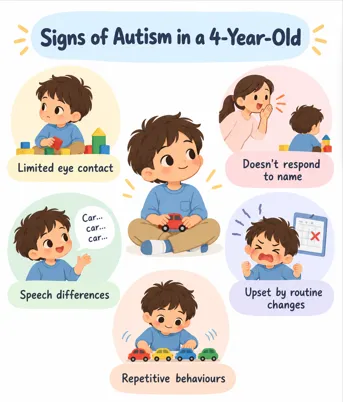
By four, most children can chat for a bit, take turns in a game, and cope with a change of plan, even if they grumble about it. When a child is on the autism spectrum, certain things keep showing up.
- Rarely looks at you or makes eye contact during play
- Doesn’t turn when you call their name, even though their hearing is fine
- Has trouble keeping a conversation going, or repeats lines from a favourite cartoon
- Falls apart when the routine changes, such as taking a different road to school
- Flaps hands, spins, or lines up toys the same way every single time
No child has all of these. The autism symptoms in 4 year old kids can be quite different from one child to the next, and the signs of autism in children may be barely noticeable in one and very obvious in another.
Seeing these signs described is often easier than reading about them. Watch this video for a clear, relatable breakdown of what autism can look like in a young child.
How Do Autism Signs Differ From Typical Behaviour at Age 4?
| What you notice | Typical 4-year-old | Possible autism signs in children |
| Meltdowns | Now and then, when students are tired | Frequent, when there are small changes. |
| Time to pass | Passes after a period of time | Passes for months |
| Where it shows up | Mostly one setting | Home, school, and park |
| Fixation on a toy | Moves to another toy | Finds it harder and harder to move on |
| Friendships | Does not initiate friendships with peers | Becomes more friendly with peers when introduced to them |
What Causes Autism in Children?
Many parents feel that, in some way, it’s their fault- their misjudgment, their actions or inactions during their pregnancy or when they were raising their kid have triggered autism. So let’s just be clear: no, there’s nothing you’ve done or didn’t do in your pregnancy or raising your child that has caused autism. Researchers have mainly been focused on genetics and early brain development as possible causes of autism. Some risk factors such as low birth weight or advanced maternal age may contribute a bit to the risk. Vaccines do not contain autism causes, and many tests have been conducted on this myth. Don’t ask yourself why this is the way it is; ask yourself what you can do now.
When Should Parents Consider an Autism Evaluation?
Many parents wait and hope their child will catch up. Sometimes that does happen, but more often it just uses up precious time.
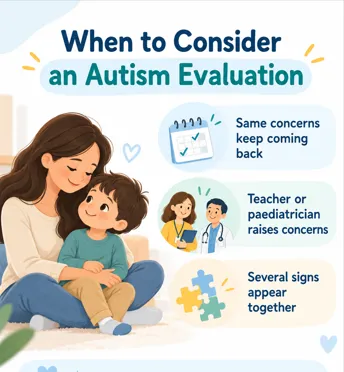
- If you’re wondering when to evaluate for autism, consider it when:
- The same worries keep coming back over a few months
- A teacher or paediatrician raises concerns without being asked
- You notice several signs together, not just one
And if you’re asking when should I get my 4 year old evaluated for autism, the honest answer is usually sooner than you’d think. An autism evaluation doesn’t stick a label on your child. It just tells you what’s going on, so you can plan.
What Happens During an Autism Evaluation at Age 4?
Parents may think that the evaluation of their 4-year-old child with autism is dreadful, but the experience of an autism evaluation for 4-year-olds is actually a long conversation and some play. A child psychiatrist or developmental paediatrician will ask about pregnancy, birth, milestones, and daily habits, observe how your child plays and responds, use structured tools during the autism assessment, and investigate whether your child has hearing or speech issues that might resemble autism.
If you don’t have a diagnosis after a single visit, you should make additional visits, as an autism diagnosis at age 4 is quite possible, and it can take two or three visits.
What Should Parents Do If They Notice These Signs?
Begin by writing things down. The doctor will get a lot more from a short note like ‘ignored his name at lunch’ or ‘cried for 20 minutes when we changed seats’ than from a general sense of worry.
If you see autism signs, make notes, talk to your paediatrician, inquire of your child’s preschool teacher what she notices, and don’t wait and see; make an early autism evaluation. When a diagnosis does occur, there’s a great deal of autism support for kids. This may involve speech and language therapy, occupational therapy, behaviour support and advice to parents. Early start children learn more rapidly, and parents are generally at ease.
FAQs
1. How do I know if my 4-year-old has autism?
You can’t be sure without a specialist. But ongoing trouble with communication, play with other children and rigid routines are good enough reasons to get your child checked.
2. Can autism be diagnosed at age 4?
Yes. A trained specialist can diagnose autism at this age, and often earlier.
3. What does autism look like in a 4-year-old?
It’s different for every child. One may barely speak and avoid eye contact, while another talks non-stop but can’t manage a two-way conversation or a change in routine.
4.Can a 4-year-old show signs of autism without a language delay?
Yes. Some children with autism develop spoken language but may have difficulties with social communication, conversation, flexibility or understanding social cues.